Every festive season there is a poster that says "Save up to ₹3.35 lakh" in a font big enough to read from the next lane. The number is real, in the sense that it sits in a dealer scheme sheet somewhere. It also belongs to one car, in specific variants, with conditions attached, and the poster leaves all of that out.
That ₹3.35 lakh is the maximum benefit listed for the Tata Curvv EV (pre-SeriesX) in one of the Navratri roundups doing the rounds this week. Sharad Navratri runs from 11 to 19 October and Dussehra falls on 20 October. Most of the brand schemes, Tata, Kia and Skoda among them, run until 31 October. So there are a couple of weeks to think, which most of us will use up on WhatsApp forwards.
Where the big numbers actually sit
Look at the top of the list and a pattern shows up quickly. Harrier EV buyers can get up to ₹2.75 lakh on selected variants, and the pre-facelift Honda Elevate carries up to ₹2.35 lakh. Further down are the City ZX at ₹1.71 lakh and the Kia Carnival at ₹1.70 lakh. Almost every big figure sits on an EV, a pre-facelift car or something on its way out.
The Elevate is the clearest example. Honda unveiled the facelifted car with prices on 6 October, starting at ₹11.80 lakh ex-showroom, so the old one at ₹2.35 lakh off looks a lot like clearance. The Toyota Glanza tells the same story, with up to ₹70,000 on outgoing stock and the new Glanza facelift launched on 14 October. Then there is the Land Cruiser 300, MY25 stock, listed at up to ₹13.38 lakh. I am sure that is lovely for the three people reading this who are shopping for a Land Cruiser.
CNBC-TV18's write-up of its FADA interview explains all of this. Aggressive schemes, it says, are limited to older and slow-moving inventory, while pricing on fresh models remains disciplined. Read that again before you feel too grateful to the dealer. Your discount is the dealer's problem, shrinking.
One scheme, taken apart
The Nexon is a good one to pull apart because the breakup is public. Selected petrol manual variants get up to ₹75,000. That is a ₹10,000 cash discount, a ₹45,000 "intervention offer", and then either ₹15,000 for an exchange or ₹20,000 for scrapping an old vehicle. Add it up and you will see that the full ₹75,000 only appears if you bring a scrappage certificate. With a normal exchange it is ₹70,000. Nobody lied, exactly. The poster just assumed you own a vehicle that is ready for the scrapyard.
Elsewhere the same sheet shows the Nexon CNG at up to ₹60,000 and the diesel at up to ₹20,000. Maruti is giving a flat ₹35,000 cash discount on the Jimny, and according to the dealer offer lists in that roundup the Thar Roxx gets nothing at all.
Why the schemes are bigger this year
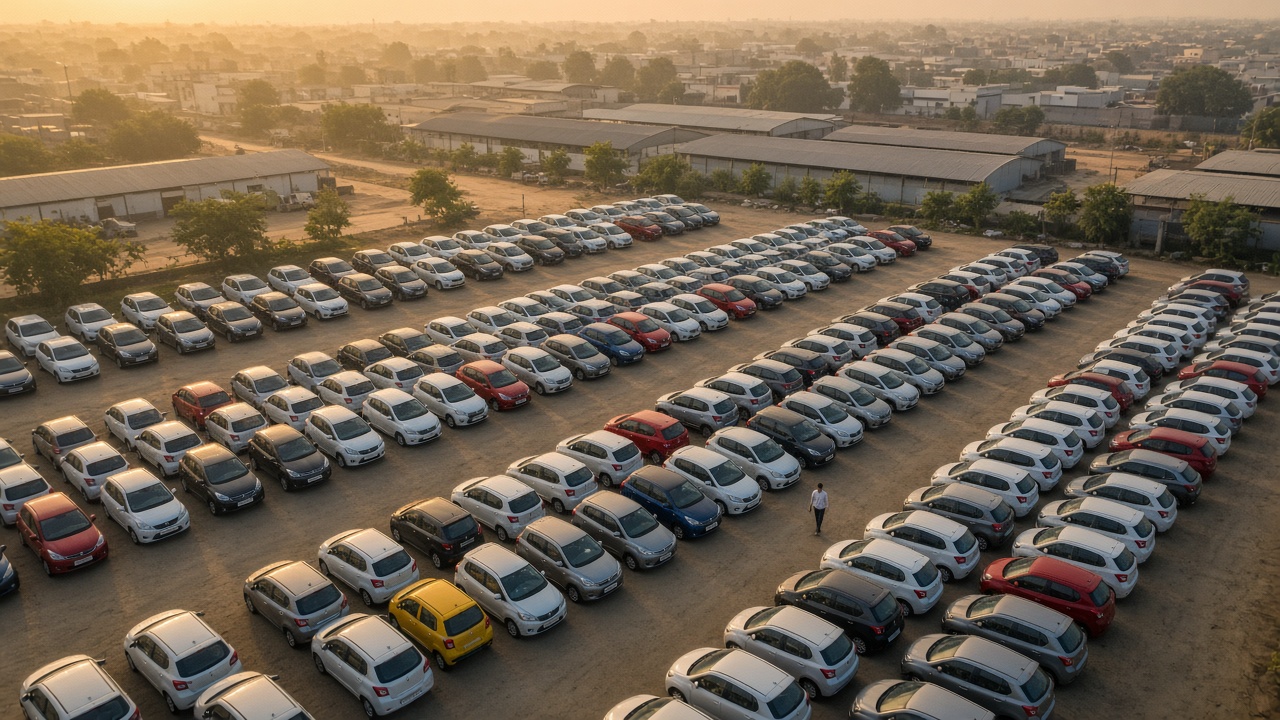
Business Standard reported that festive schemes are higher than last year because the price hikes since GST 2.0 have eaten part of the tax benefit. Companies had pulled back on consumer offers after the GST cuts made cars cheaper, and now they are bringing them back to cover the gap. FADA's own numbers also show dealers sitting on roughly 43 to 45 days of passenger vehicle stock, against about 60 days at this point last year.
So dealers want to move cars. That gives you some leverage, though not as much as the poster suggests.
What I would do at the showroom
Ask for the breakup in writing. Cash discount, exchange bonus, scrappage benefit, loyalty and corporate offers are all separate lines, and you may qualify for only some of them. Ask for the cash discount on its own, because that is the only part that is truly yours whatever you drive in with.
Check the manufacturing date. A big discount on a car built last year is a fair trade only if you plan to keep it for a long time. The roundup itself warns that this kind of stock carries lower resale value, which is just common sense: the next buyer will see an older design and bargain accordingly. I would take a smaller discount on a fresh car over a bigger one on stock that has been sitting since last year, unless I planned to drive it for a decade.
Compare on-road prices, not ex-showroom. Insurance, registration and the accessories a dealer likes to bundle can quietly eat a good chunk of whatever you saved. And book early if you want a popular variant, because the nice ones tend to disappear before Dussehra.
Diwali falls in November this year, so there is some breathing room. The catch is that the schemes in this list mostly end on 31 October, and what the dealers offer in November is anyone's guess. Every figure above is an "up to" figure, and your own number will depend on variant, city, stock and what you have in the driveway. Treat the poster as the opening bid, not the final price.